Introduction
Personal information appears in more places than many people realize. Names, addresses, account references, medical information, membership details, customer numbers, and other identifying information can appear on envelopes, statements, bills, shipping labels, forms, and printed documents. Once a piece of paper is no longer needed, simply placing it in the trash may not always be the most thoughtful way to dispose of information that someone else could potentially read.
One approach to reducing the visibility of information on paper is an identity protection roller stamp. Rather than cutting or shredding every document, a privacy roller uses a pattern of ink to cover printed information. The goal is to make selected text harder to read before a document or envelope is discarded.
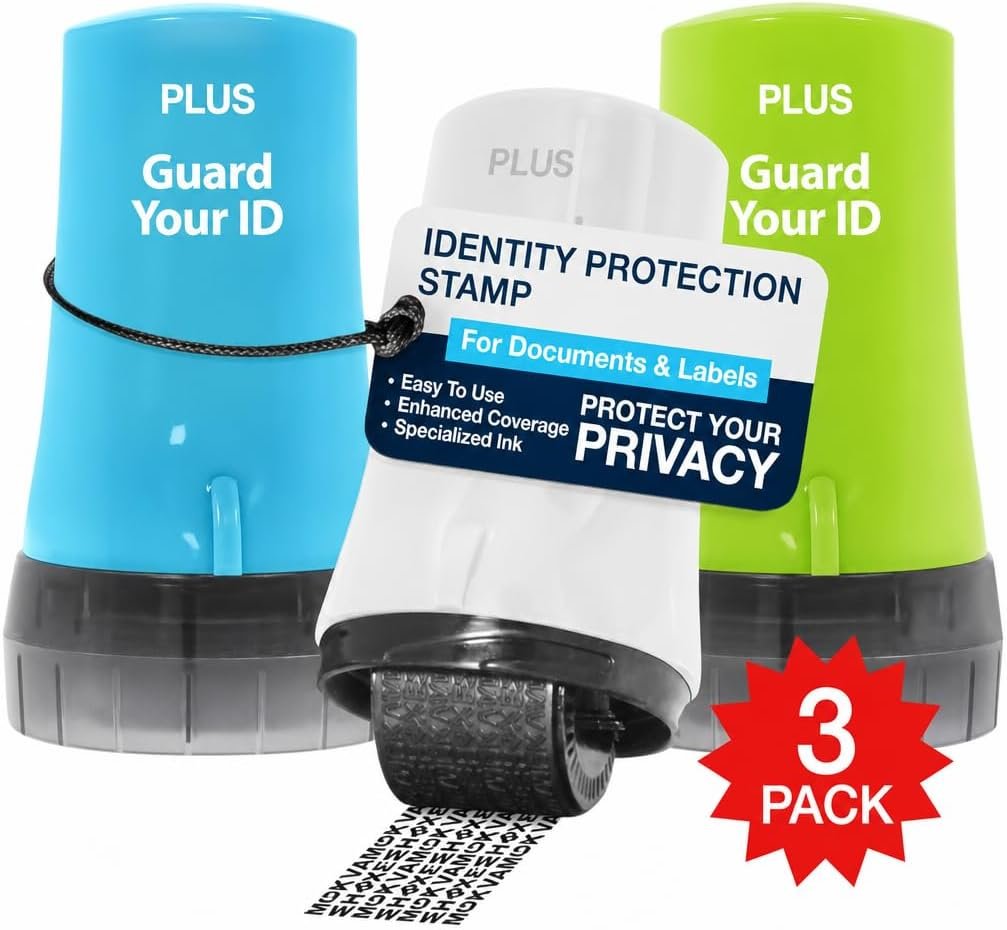
The Guard Your ID Identity Theft Protection Roller Stamp, 3-Pack for Mail is designed around this concept. The three-pack format provides multiple rollers that can potentially be kept in different locations, such as a home office, kitchen, workspace, or near a recycling area. This can make it easier to incorporate information-covering into an everyday paper-disposal routine.
A privacy roller should not be considered a complete identity-theft prevention system. It is one physical privacy measure among many. Its usefulness depends on how it is applied, what type of information is being covered, the condition of the paper, and whether enough ink is applied to obscure the relevant text.
This guide explores the product category from a practical and educational perspective. It explains how identity protection roller stamps work, where they may be useful, what types of documents can benefit from them, important limitations to understand, and how they compare with other methods of disposing of sensitive paper information.
What Is an Identity Protection Roller Stamp?
An identity protection roller stamp is a handheld privacy tool designed to cover printed information on paper.
Instead of using a conventional rubber stamp to apply readable text or a decorative pattern, a privacy roller applies an opaque or visually confusing pattern across an area of printed information.
The pattern is intended to make the original text more difficult to recognize at a glance.
This can be particularly useful for documents containing information such as:
- Names
- Street addresses
- Account references
- Customer information
- Membership details
- Mailing information
- Other printed identifiers
The roller format allows users to move the stamp across a line or block of text rather than manually coloring over each character.
This makes it suitable for routine paper disposal where speed and convenience matter.
Key Features
Privacy-Focused Roller Design
The primary function of the Guard Your ID roller stamp is privacy-oriented coverage.
The roller applies a pattern designed to interfere with the readability of printed information. This can help reduce the amount of personal information visibly exposed when paper is discarded.
The approach is different from simply tearing a document in half.
A torn envelope may still contain an intact name or address. A privacy roller provides a way to target the printed area directly.
Three-Piece Pack
The product is supplied as a 3-pack.
Multiple rollers can be useful for households or workspaces where paper is discarded in different locations.
For example, one could be kept near the front door for incoming mail, another in a home office, and another near a general paper-recycling area.
This can reduce the need to carry a single tool from room to room.
It can also provide a backup if one roller becomes unavailable.
Roller Application
The roller mechanism is designed to make application relatively straightforward.
Instead of pressing a stationary stamp repeatedly, the user rolls the tool across the area that needs to be covered.
This can be useful when dealing with addresses printed in a horizontal format on envelopes or labels.
The rolling motion can also cover multiple lines when the tool is positioned appropriately.
Intended for Mail and Paper
The product is particularly relevant to everyday mail.
Envelopes, shipping labels, statements, and other paper items often display identifying information prominently.
A privacy roller can provide a simple step between opening mail and disposing of it.
The tool can also be useful for other printed paper, provided the ink can effectively cover the information and the surface is appropriate for the roller.
Compact Storage
A roller stamp is generally much smaller than a paper shredder.
This allows it to be stored in places where a larger disposal device would be impractical.
A compact privacy tool can remain near a desk, mail station, or recycling bin and be used whenever necessary.
How It Can Be Used
Covering Names and Addresses on Envelopes
One of the most straightforward uses is covering a name and mailing address after an envelope is no longer needed.
Rather than leaving the information visible, the user can apply the roller over the relevant area.
It is important to inspect the result afterward.
If portions of the name or address remain clearly readable, additional coverage may be appropriate.
Reducing Exposure of Information on Mail
Mail can contain more than an address.
Depending on the sender, an envelope may display a company name, account-related reference, membership information, or other details.
A privacy roller can be used selectively on areas that the user does not want to remain plainly visible.
This can be especially useful for households that receive a large amount of printed correspondence.
Preparing Shipping Labels for Disposal
Shipping labels often contain names and addresses.
After a package has been received, the label may remain attached to the packaging.
Instead of throwing the packaging away with the label fully visible, a privacy roller can be applied to the printed information.
The user should check the entire label rather than assuming that only the recipient’s name needs to be covered.
Home Office Paper Disposal
People who work from home may accumulate printed documents containing personal or business information.
Examples include:
- Printed forms
- Mailing labels
- Account correspondence
- Appointment documents
- Invoices
- Internal notes
- Draft paperwork
A privacy roller can be kept near the home office recycling or disposal area to make privacy protection part of the normal workflow.
Family Mail Management
A three-pack can also support multiple household locations.
One roller might be kept where mail is opened, while another remains in a home office.
A third can be stored as a spare or placed in another frequently used area.
The idea is to make privacy protection convenient enough that it becomes a routine rather than an occasional task.
Creating a Simple Paper Privacy Routine
A roller stamp becomes more useful when it is incorporated into a consistent disposal routine.
A simple process might look like this:
Step 1: Sort the Mail
Separate documents that can be discarded from documents that need to be kept.
Step 2: Identify Sensitive Information
Look for names, addresses, account references, customer numbers, barcodes, labels, and other information that should not remain openly visible.
Step 3: Apply the Roller
Move the privacy roller across the relevant areas.
Make sure the coverage extends beyond the exact characters rather than leaving readable edges.
Step 4: Inspect the Result
Look at the paper from different angles and check whether the original information remains recognizable.
If important information is still visible, additional coverage may be necessary.
Step 5: Dispose of the Paper Appropriately
Once the information has been adequately obscured, the paper can be disposed of according to the user’s normal recycling or waste procedures.
For particularly sensitive documents, a shredder may still be preferable.
Who It May Be Suitable For
Households That Receive Regular Mail
A household receiving bills, statements, catalogs, medical correspondence, shipping labels, and other printed materials may encounter many pieces of paper containing personal information.
A privacy roller can provide an additional step in the disposal process.
Home Office Users
People who work remotely may handle documents containing their own information or business-related material.
Keeping a roller near a home office can make it easier to address printed information before disposal.
Small Businesses
Small businesses may handle paper containing customer names, mailing information, order details, and other business records.
A privacy roller can be useful for low-risk paper disposal where a full document shredder is not necessary.
However, businesses should follow their applicable privacy, records-management, and data-protection requirements.
Students
Students may receive mail, forms, shipping labels, financial correspondence, or school-related documents containing personal information.
A small privacy tool can be stored in a dorm room, apartment, or home study area.
People Who Prefer Compact Privacy Tools
Not everyone wants to operate a shredder for every envelope.
A compact roller can be useful when the goal is to quickly obscure a limited amount of information.
Important Things to Consider
A Privacy Roller Does Not Guarantee Identity Theft Protection
The phrase “identity theft protection” should be understood carefully.
A roller stamp can help obscure printed information on discarded paper, but it cannot prevent identity theft by itself.
Identity theft can involve many different sources, including compromised online accounts, phishing, stolen credentials, data breaches, fraudulent transactions, and other forms of information exposure.
Using a privacy roller is therefore best viewed as one layer of physical information management.
Coverage Matters
The effectiveness of a privacy roller depends heavily on how thoroughly the information is covered.
If only part of an address is obscured, the remaining characters may still reveal useful information.
Users should pay attention to:
- The beginning of names
- Street numbers
- Apartment numbers
- ZIP codes
- Account references
- Barcodes
- Other identifying text
A quick pass may not always provide enough coverage.
Some Information May Require Shredding
A roller stamp is not necessarily appropriate for every document.
Highly sensitive paperwork may be better destroyed using a cross-cut or micro-cut shredder, particularly when the entire document contains sensitive information.
Examples may include certain financial records, tax documents, legal paperwork, or documents containing extensive personal information.
The appropriate disposal method depends on the sensitivity of the material.
Barcodes Can Contain Information
Users should not assume that covering the visible name and address is always sufficient.
Some mail and labels contain barcodes or other machine-readable elements.
If the goal is to prevent information from remaining accessible, users should consider whether other identifying information remains on the paper.
Different Paper Surfaces May Behave Differently
Ink application can vary depending on the paper.
Glossy surfaces, coated labels, thermal paper, and other specialty materials may behave differently from ordinary envelopes or office paper.
The user should check the result after applying the roller rather than assuming every surface will provide identical coverage.
Ink Coverage Can Vary
Like other ink-based products, a roller stamp can eventually require replacement or replenishment depending on its construction.
Users should follow the manufacturer’s guidance for maintenance and replacement.
If the printed pattern becomes faint, the privacy effect may be reduced.
Test Before Disposing of Important Documents
If someone is using a privacy roller for the first time, it can be sensible to test it on ordinary unwanted paper.
This allows the user to understand how much pressure and how many passes are needed to create adequate coverage.
Testing also helps identify whether the ink behaves as expected on a particular paper surface.
Privacy Roller vs. Shredding
Shredding is one of the most established ways to destroy paper containing sensitive information.
A cross-cut or micro-cut shredder physically breaks paper into small pieces, making reconstruction substantially more difficult than simply tearing a page.
A privacy roller works differently.
It does not destroy the paper. Instead, it obscures selected printed information.
This can make a roller more convenient for everyday mail where only an address or other limited section needs to be concealed.
For highly sensitive documents, shredding may be more appropriate.
The two methods can also be used together. For example, a household could use a roller for ordinary envelopes and use a shredder for documents containing extensive financial or personal information.
Privacy Roller vs. Permanent Marker
A permanent marker can be used to manually cover information.
This method is inexpensive and widely available, but it can be slower and less uniform.
A roller provides a dedicated application mechanism designed specifically for repeated privacy coverage.
A marker may still be useful as a backup, particularly when the information appears in an unusual shape or location that is difficult to cover with a roller.
Privacy Roller vs. Tearing Paper
Tearing an envelope or document into a few pieces does not necessarily make the information unreadable.
A person’s name and address may remain intact on one piece.
A privacy roller targets the printed information directly.
However, tearing and shredding can be combined with obscuring techniques when appropriate.
Privacy Roller vs. Digital Document Management
Reducing paper is another way to reduce physical exposure.
Electronic statements, digital receipts, and online account management can reduce the number of documents entering a household.
However, going paperless does not eliminate privacy concerns. Digital information has its own risks, including account security, phishing, malware, and unauthorized access.
Physical and digital privacy practices should therefore be considered separately.
Practical Mail Privacy Tips
A privacy roller works best as part of a broader approach to handling mail.
Remove Labels From Packages
Before recycling or discarding packaging, inspect all sides for labels and printed information.
Avoid Leaving Mail in Public Areas
Mail containing personal information should not be left unattended in shared spaces.
Keep Important Documents Secure
Documents that need to be retained should be stored in an appropriate location rather than simply placed in an open recycling container.
Consider Digital Statements
Where appropriate, switching to electronic statements can reduce the amount of paper containing personal information.
Protect Digital Accounts
Physical document security is only one part of personal information management. Strong passwords, multifactor authentication, and careful handling of suspicious messages can help address digital risks.
Use Appropriate Destruction for Highly Sensitive Records
Some records deserve more thorough destruction than a roller stamp alone can provide.
A document shredder may be appropriate for highly sensitive paperwork.
Using the Three-Pack Strategically
The three-pack configuration offers an opportunity to establish multiple privacy stations.
For example:
Mail area: Keep one roller where incoming mail is opened and sorted.
Home office: Keep another near a desk or printer.
Storage or recycling area: Place the third where discarded paper is prepared for recycling.
This approach can reduce the inconvenience of searching for the tool each time a document needs to be processed.
The same concept can work in a small business. One roller can remain at reception, another in an office, and another near a records-management area, provided the organization has appropriate procedures for sensitive information.
Frequently Asked Questions
What is the Guard Your ID Identity Theft Protection Roller Stamp?
It is a privacy-oriented roller stamp designed to obscure printed information on paper. The product is supplied as a three-pack and is intended for uses such as mail and other paper containing identifying information.
What type of information can a privacy roller cover?
It can be used to obscure printed information such as names, addresses, account references, labels, and other text appearing on suitable paper surfaces.
Does the roller completely remove personal information?
No. A privacy roller does not physically remove the information from the paper. It applies an ink pattern intended to make the underlying text harder to read.
Is a privacy roller the same as a paper shredder?
No. A roller obscures information while a shredder physically destroys the paper into smaller pieces. Each method has different applications.
Can a privacy roller replace shredding?
Not in every situation. Highly sensitive documents may warrant shredding, particularly when the entire document contains substantial personal or financial information.
Can it be used on envelopes?
A privacy roller is particularly suited to mail-related applications, including covering names and addresses on envelopes, provided the surface is appropriate for the ink.
Can it be used on shipping labels?
It may be useful for covering identifying information on suitable shipping labels. Users should inspect the entire label and consider whether barcodes or other information also need to be addressed.
Why is the product sold as a three-pack?
Multiple rollers can be stored in different locations, such as a mail area, home office, and recycling station. The three-pack can also provide an extra unit for another household member or workspace.
Is the roller useful for businesses?
It can be useful for routine paper handling, but businesses should also follow applicable records-management and privacy requirements. Sensitive records may require more comprehensive destruction procedures.
Does the roller protect against all forms of identity theft?
No. It addresses one physical aspect of information disposal. Identity theft can also occur through online accounts, phishing, data breaches, stolen credentials, and other channels.
How can I tell whether enough information has been covered?
Inspect the document after rolling over it. Important identifying text should not remain easily readable. If portions remain clear, additional coverage or another disposal method may be appropriate.
Can the roller be used on glossy paper?
The result can vary depending on the surface. Glossy, coated, thermal, and specialty papers may behave differently from ordinary paper. Testing the roller on an unwanted piece of similar material can help determine how well it covers the surface.
Should barcodes be covered too?
If a barcode contains identifying or tracking information that the user wants to keep from being readily accessible, it should be considered as part of the overall disposal process. The appropriate approach depends on the document and the information it contains.
Is a privacy roller useful for everyday mail?
It can be useful for routine mail disposal where the goal is to obscure visible personal information before the paper is discarded.
Can children use a privacy roller?
Because the product contains ink and is intended for privacy-related document handling, adult guidance may be appropriate for younger children. It should also be stored according to the manufacturer’s recommendations.
Conclusion
The Guard Your ID Identity Theft Protection Roller Stamp, 3-Pack for Mail is designed to address a simple but common household problem: printed personal information that remains visible on paper after the document is no longer needed.
Its roller format provides a convenient way to obscure names, addresses, labels, and other selected information without requiring the entire piece of paper to be destroyed. The three-pack can also make it practical to maintain privacy tools in several locations around a home or workspace.
The key point is to understand what a privacy roller can and cannot do. It is a physical information-disposal aid, not a complete identity-theft prevention solution. Its effectiveness depends on adequate coverage, appropriate paper surfaces, and careful attention to other identifying information such as barcodes and account references.
For routine mail, shipping labels, household paperwork, and other documents where limited areas of information need to be obscured, a privacy roller can be a convenient addition to a paper-management routine. For highly sensitive records, shredding or another appropriate destruction method may provide a more thorough solution.
Used alongside sensible digital-security practices, careful document storage, and appropriate disposal methods, a privacy roller can become one small part of a broader approach to protecting personal information.
Leave a Reply